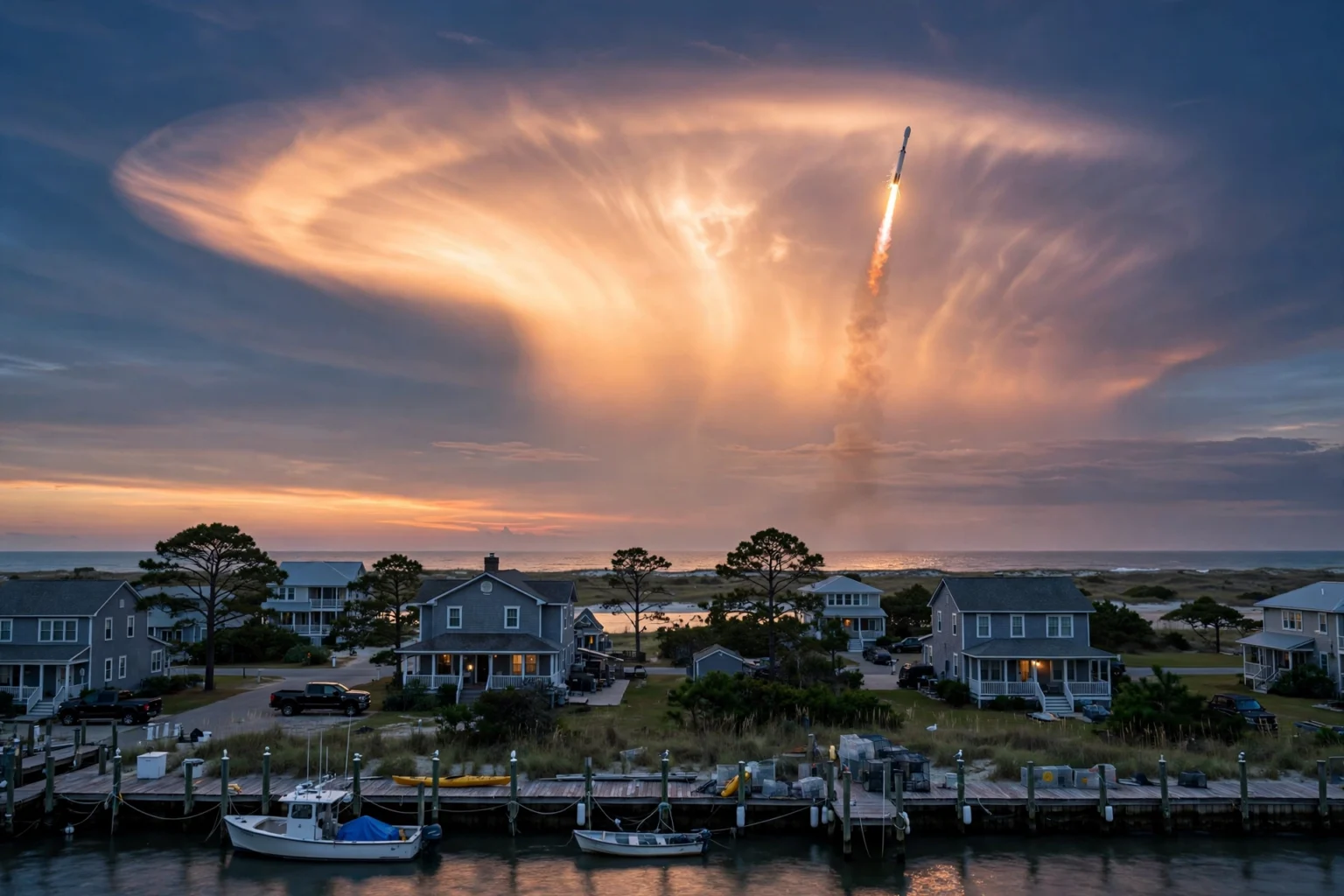

Early risers along the United States east coast were treated to an unusual sight this week when a SpaceX rocket launch at dawn produced a glowing, billowing shape high in the sky that many witnesses described as a jellyfish. Photographs shared from coastal communities showed a bright plume expanding against the dark morning sky, with delicate tendrils trailing behind it as sunlight caught exhaust gases far above the ground.
The phenomenon, often called a space jellyfish, is not a cloud in the ordinary weather sense and it is not a sign of anything going wrong. It is what happens when a rocket climbs into the thin upper atmosphere at exactly the right time of day, while the surface below is still in darkness.
What creates the jellyfish effect?
A rocket exhaust plume expands much more widely at high altitude than it does near the ground because the surrounding air pressure is so low. Instead of a tight, fiery jet, the gases spread into a broad, translucent bulb. When a launch takes place shortly before sunrise or shortly after sunset, sunlight can still reach that high plume even though the observer below is standing in twilight or darkness. The contrast makes the plume glow, sometimes in soft blues, pinks and whites, while the darker sky behind it makes the edges look sharply defined.
Reporting on this week’s display by The Guardian described witnesses watching the shape grow and change over several minutes before it slowly dispersed. That slow evolution is part of the spectacle. As the rocket continues downrange and the plume expands, the tendril-like trails left by earlier stages and steering movements can twist in high-altitude winds, giving the whole formation its marine-creature appearance.
Why timing matters more than the rocket itself
Almost any launch can produce some version of this effect, but the classic jellyfish needs a narrow window. Launch too early and the plume stays dark against a dark sky. Launch too late and the whole sky brightens, washing out the glow. The most dramatic displays tend to occur roughly half an hour to an hour before sunrise, when the geometry lines up: the sun below the horizon for viewers, but already illuminating the rarefied layers tens of miles up.
Weather at ground level matters too. Clear skies, low humidity near the surface and a good view toward the launch direction all help. Coastal viewers often get the best seats because there are fewer obstructions over the water and less light pollution competing with the faint outer edges of the plume. Readers who follow sky and weather patterns will recognise the same ingredients that make other dawn phenomena so memorable, a theme we explored in our coverage of the early atmospheric river season arriving in the Pacific Northwest.
A busier sky, and more chances to see it
Launch cadence from Florida and California has increased sharply in recent years, driven by satellite deployment, cargo missions and crewed flights. That means dawn and dusk displays that once might have happened a few times a decade are now a more regular occurrence for east coast residents. Social media has amplified the effect: a single launch can now produce thousands of photographs within minutes, taken from hundreds of miles apart, allowing the shape of the plume to be appreciated at a scale no single viewer could manage.
For the Northwest, most launches are too distant to produce the same view, but the region has its own sky-watching rewards at this time of year, from meteor showers to the shifting cloudscapes that arrive with the autumn rains, as our recent guide to preparing for the Pacific Northwest rainy season notes. The shared lesson is simple: the best displays reward people who look up at the right moment, often in the quiet minutes before the working day begins.
How to catch the next one
If you want to see a space jellyfish for yourself, start by watching launch schedules and paying attention to the time of liftoff relative to local sunrise or sunset. Arrive early, choose a spot with an unobstructed view toward the launch site, and let your eyes adjust to the dark rather than staring at a bright phone screen. A camera with even a modest long-exposure setting can capture colours and structure that the naked eye only hints at, but many veteran watchers advise experiencing the first one without a lens in the way.
It is also worth managing expectations. Some plumes are compact and bright, others diffuse and ghostly, and a scrubbed launch or a layer of coastal cloud can end the show before it starts. When everything lines up, the result is a few silent, luminous minutes that look almost alive in the sky.
This week’s east coast display will fade, as all of them do, within the hour. The photographs, however, will keep circulating, and the next dawn launch is never far away on the modern schedule. For anyone who missed it, the advice from seasoned launch watchers is unchanged: set the alarm, check the forecast, and look east. The sky, increasingly, is putting on a show worth waking for.