

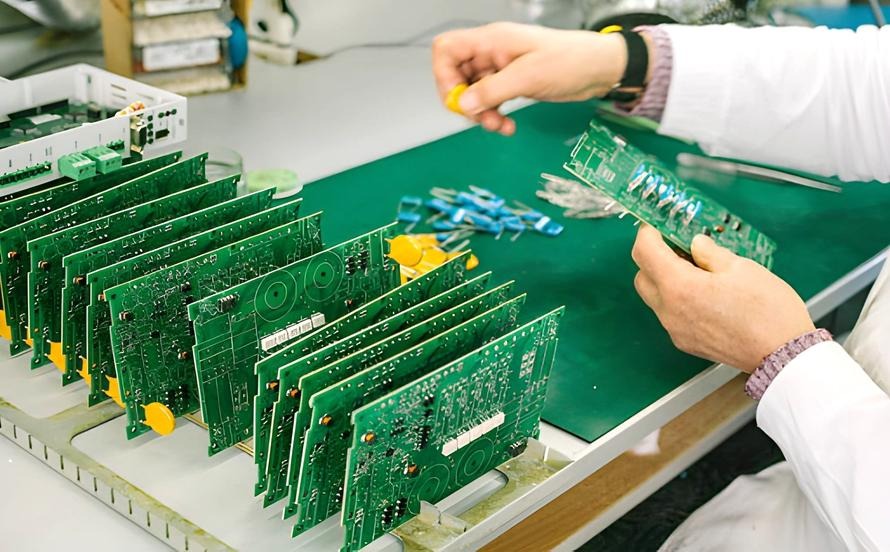
Radar technology has become an indispensable part of modern society, supporting applications that range from aviation and defense to automotive safety, weather monitoring, industrial automation, and maritime navigation. As radar systems continue to evolve, they require increasingly sophisticated electronic components capable of processing high-frequency signals with exceptional precision and reliability. At the core of every radar system is the Radar PCB, a specialized printed circuit board engineered to handle complex radio frequency (RF) signals while maintaining excellent electrical performance under demanding operating conditions.
Unlike conventional printed circuit boards, radar PCBs are designed using advanced materials, controlled impedance structures, and highly accurate manufacturing processes to minimize signal loss and maintain stable performance at microwave and millimeter-wave frequencies. Even the smallest variation in material properties, conductor geometry, or manufacturing precision can affect signal integrity and reduce the overall accuracy of a radar system.
Because of these demanding requirements, manufacturers rely on experienced Radar PCBs manufacturer companies that possess the technical expertise, specialized equipment, and quality management systems necessary to produce high-performance circuit boards for critical applications.
This article explores radar PCB technology, its manufacturing process, key advantages, applications, and the importance of partnering with an experienced radar PCB manufacturer.
What Are Radar PCBs?
Radar PCBs are specialized printed circuit boards developed specifically for radar systems that transmit, receive, and process high-frequency electromagnetic signals. These circuit boards support components such as antennas, power amplifiers, low-noise amplifiers, mixers, filters, oscillators, digital processors, and signal conditioning circuits that work together to detect objects and measure distance, speed, direction, and position.
Unlike general-purpose PCBs, radar circuit boards must maintain highly controlled electrical characteristics across extremely high operating frequencies. Signal integrity, impedance consistency, dielectric stability, and thermal management are all critical design considerations that directly influence radar performance.
To achieve these requirements, radar PCBs often utilize high-frequency laminate materials such as Rogers, PTFE-based substrates, ceramic-filled composites, or other low-loss dielectric materials rather than standard FR-4 laminates.
The result is a circuit board capable of supporting accurate high-speed signal transmission while minimizing insertion loss, reflection, and electromagnetic interference.
Why Radar PCBs Require Specialized Design
High-frequency electronic signals behave very differently from conventional low-speed digital signals. At microwave and millimeter-wave frequencies, even small inconsistencies in conductor width, dielectric thickness, or via geometry can significantly affect electrical performance.
Radar PCBs require carefully controlled impedance to ensure signals travel efficiently throughout the circuit without excessive reflections or attenuation. Designers must precisely calculate transmission line dimensions while considering dielectric constants, conductor thickness, copper roughness, and material tolerances.
Thermal management is another major consideration because many radar systems operate at relatively high power levels. Excessive heat may alter electrical characteristics and reduce component reliability, making proper thermal design essential.
Mechanical stability is equally important. Radar systems installed in vehicles, aircraft, satellites, ships, and industrial equipment often experience vibration, temperature fluctuations, and harsh environmental conditions. The PCB must maintain stable electrical performance throughout its operational life despite these challenges.
The Radar PCB Manufacturing Process
Manufacturing radar PCBs requires advanced production technology and extremely tight process control. The process begins after engineers complete the PCB layout using specialized RF design software capable of accurately modeling high-frequency circuit behavior.
Before production begins, manufacturers conduct comprehensive Design for Manufacturability (DFM) analysis to verify that transmission lines, controlled impedance structures, grounding techniques, and dielectric materials meet manufacturing capabilities.
Material selection is particularly important. High-frequency laminates with stable dielectric properties are carefully chosen according to the radar operating frequency and environmental requirements.
Precision imaging equipment transfers circuit patterns onto copper-clad laminates before chemical etching forms the conductive traces. Laser drilling and mechanical drilling create vias that connect multiple circuit layers while maintaining strict positional accuracy.
Controlled impedance fabrication requires continuous monitoring throughout production to ensure conductor widths, dielectric thickness, and copper plating remain within extremely tight tolerances.
After fabrication, solder mask application, surface finishing, and silkscreen printing are completed before every board undergoes detailed inspection and electrical testing.
Advantages of Radar PCB Technology
Radar PCBs provide numerous advantages that enable reliable high-frequency system performance. One of the most significant benefits is superior signal integrity. Carefully controlled impedance structures reduce signal reflections while maintaining consistent transmission characteristics across complex RF circuits.
Low dielectric loss materials minimize signal attenuation, allowing radar systems to detect weaker reflected signals over greater distances. This improved sensitivity directly enhances measurement accuracy and detection capability.
Excellent thermal performance helps maintain stable operating temperatures, protecting sensitive RF components while preserving electrical characteristics during continuous operation.
Radar PCBs also offer exceptional reliability under demanding environmental conditions. High-quality materials resist moisture absorption, temperature variation, vibration, and mechanical stress, ensuring consistent performance throughout the product’s operational life.
The ability to support multilayer architectures further enables engineers to integrate increasingly sophisticated radar systems within compact electronic assemblies while maintaining outstanding electrical performance.
Applications of Radar PCBs
Radar PCB technology supports a wide range of industries that rely on precise object detection and high-frequency communication. The automotive industry represents one of the fastest-growing application areas, utilizing radar systems in advanced driver assistance systems (ADAS), adaptive cruise control, collision avoidance, blind-spot monitoring, automatic emergency braking, and autonomous driving technologies.
Aerospace and aviation industries depend on radar PCBs for aircraft navigation systems, weather radar, air traffic control, terrain mapping, and satellite communication equipment. These applications demand exceptional reliability under extreme operating conditions.
Defense systems rely heavily on advanced radar technology for surveillance, missile guidance, target tracking, electronic warfare, and battlefield awareness. Precision-manufactured radar PCBs help ensure reliable system performance in mission-critical environments.
Marine navigation systems use radar technology to detect vessels, coastlines, weather conditions, and obstacles during both commercial and military operations.
Industrial automation applications increasingly incorporate radar sensors for object detection, distance measurement, robotic navigation, warehouse automation, and process monitoring.
Weather forecasting systems, scientific research equipment, space exploration technologies, and intelligent transportation infrastructure also utilize sophisticated radar PCB technology.
Why Choosing an Experienced Radar PCBs Manufacturer Matters
Manufacturing radar circuit boards requires specialized expertise beyond conventional PCB fabrication. An experienced Radar PCBs manufacturer understands the unique electrical, mechanical, and manufacturing requirements associated with high-frequency circuit design.
Professional manufacturers provide valuable engineering support throughout product development by conducting Design for Manufacturability reviews that optimize transmission line geometry, layer stack-up, material selection, and impedance control before production begins.
Leading manufacturers invest in advanced fabrication technologies including laser direct imaging, precision drilling systems, automated optical inspection, impedance measurement equipment, and high-frequency material processing capabilities.
Their experience with microwave laminates, multilayer RF structures, thermal management, and electromagnetic compatibility enables customers to achieve optimal radar system performance while reducing manufacturing risks.
Working with an experienced manufacturer also improves consistency between prototype development and high-volume production, ensuring stable electrical performance across every manufactured board.
Quality Assurance in Radar PCB Manufacturing
Quality assurance is essential throughout radar PCB production because manufacturing precision directly influences high-frequency electrical performance. Every production stage requires careful inspection to maintain dimensional accuracy and controlled impedance.
Manufacturers verify laminate properties before fabrication begins, ensuring dielectric constants, thickness, and material consistency meet design requirements. During production, conductor widths, spacing, copper thickness, and via positioning are continuously monitored.
Automated Optical Inspection identifies fabrication defects while X-ray inspection evaluates hidden multilayer structures and plated vias. Controlled impedance testing verifies that transmission lines meet specified electrical characteristics.
Additional testing may include insertion loss measurement, return loss analysis, thermal cycling, environmental stress screening, vibration testing, and electrical reliability evaluation depending on customer requirements.
Many leading manufacturers maintain internationally recognized certifications such as ISO 9001, IPC standards, UL certification, IATF 16949 for automotive electronics, AS9100 for aerospace manufacturing, and RoHS compliance, demonstrating their commitment to consistent product quality.
Future Trends in Radar PCB Technology
Radar technology continues evolving rapidly as industries adopt autonomous vehicles, smart transportation systems, advanced robotics, 5G communication infrastructure, and next-generation defense technologies. These innovations require increasingly sophisticated radar circuit boards capable of supporting higher operating frequencies and greater processing complexity.
Manufacturers are investing in ultra-low-loss materials, finer conductor geometries, embedded passive components, advanced multilayer architectures, and intelligent manufacturing systems to support emerging radar technologies.
Millimeter-wave radar operating at frequencies above 77 GHz is becoming increasingly common in automotive safety systems and advanced communication equipment. Producing these circuit boards requires even greater manufacturing precision and material stability.
Artificial intelligence-driven manufacturing, automated inspection systems, and digital process control will further improve production accuracy while supporting the continued advancement of radar electronics.
Conclusion
Radar PCBs are fundamental to the operation of modern radar systems, providing the precision, signal integrity, thermal stability, and reliability required for high-frequency electronic applications. Their specialized design enables accurate object detection and dependable performance across industries such as automotive, aerospace, defense, industrial automation, telecommunications, and scientific research.
Choosing an experienced Radar PCBs manufacturer ensures access to advanced manufacturing technologies, specialized RF engineering expertise, rigorous quality control, and consistent production capabilities. As radar technology continues to advance with the growth of autonomous systems, intelligent transportation, and next-generation communication networks, high-quality radar PCBs will remain a critical component driving innovation and enabling the future of high-frequency electronics.



